Wednesday, July 24, 2013

TUESDAY POEM | The Rain Stick by Seamus Heaney


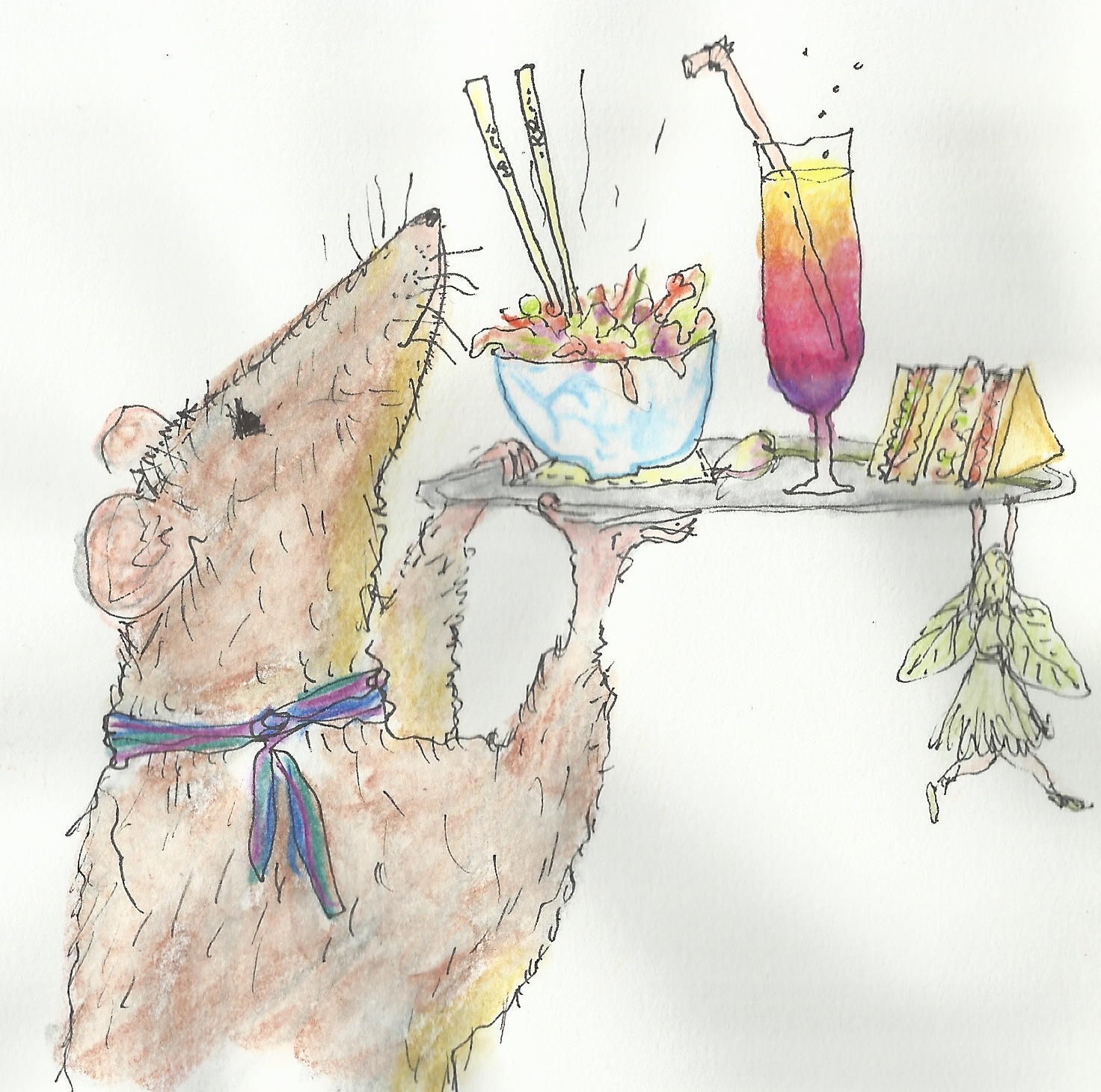
Upend the rain stick and what happens next is a music you never would have known to listen for (detail)
Charcoal & Pastel on Paper  |  CB  |  c. 2002


                                         THE RAIN STICK 

                                         Upend the rain stick and what happens next
                                         Is a music that you never would have known
                                         To listen for. In a cactus stalk
                                         Downpour, sluice-rush, spillage and backwash
                                         Come flowing through. You stand there like a pipe
                                         Being played by water, you shake it again lightly
                                         And diminuendo runs through all its scales
                                         Like a gutter stopping trickling. And now here comes
                                         A sprinkle of drops out of the freshened leaves,
                                         Then subtle little wets off grass and daisies;
                                         Then glitter-drizzle, almost-breaths of air.
                                         Upend the stick again. What happens next
                                         Is undiminished for having happened once,
                                         Twice, ten, a thousand time before.
                                         Who cares if all the music that transpires
                                         Is the fall of grit or dry seeds through a cactus?
                                         You are like a rich man entering heaven
                                         Through the ear of a raindrop. Listen now again.


                                         Seamus Heaney


I unpacked this drawing last week, one of a batch I've had stored away in my little 'side room'. I'd not visited this particular image for a very long time and was surprised by the ways in which it seems - at least, to me - to speak into our current times. Seamus Heaney's Rain Stick provided the original prompt way back in the early 2000s but there's a lot more going on here than the music of that poem. It's always a mystery to me to discover the questions that make their way into our work without our knowing it and without our conscious participation (even when we think we're fully, mindfully engaged?). Behind this image, I found another drawing I'd long considered 'lost', 'gone', 'evaporated' - what was I thinking when I taped it in behind the Rain Stick? (I might post it here some time; it shows a sun dial atop a craggy outcrop - an exploration into Time after repeated readings of T. S. Eliot's Burnt Norton.) 

Life is certainly full of unexpected surprises at the moment, including - yesterday - a visit to my garden from a broody, rust-coloured hen. . . lovely! I wonder if she left an egg amongst the red-legged silver beet?  


This week's editor on the Tuesday Poem hub is Harvey Molloy (his accompanying commentary is exquisite)
with the tender poem Tika


                              "Goodbye takes the form of a blessing.
                              My family press tika on our foreheads
                              rupees into my palm.

                              Mountain-high through time and air
                              the red paint dries, the rice grains fall
                              leaving a trail that could surely lead us home. . . " Saradha Koirala


Upend the rain stick and what happens next is a music you never would have known to listen for
Charcoal & Pastel on Paper  |  CB  |  c. 2002


Thursday, July 18, 2013

TUESDAY POEM (on a Thursday?) | THINGS by Lisel Mueller


detail from Today, a painted response to Kay MacKenzie-Cooke's poem Life's Work  |  CB 2013


                                       THINGS 


                                       What happened is, we grew lonely
                                       living among the things,
                                       so we gave the clock a face,
                                       the chair a back,
                                       the table four stout legs
                                       which will never suffer fatigue.


                                       We fitted our shoes with tongues
                                       as smooth as our own
                                       and hung tongues inside bells
                                       so we could listen
                                       to their emotional language,


                                       and because we loved graceful profiles
                                       the pitcher received a lip,
                                       the bottle a long, slender neck.


                                       Even what was beyond us
                                       was recast in our image;
                                       we gave the country a heart,
                                       the storm an eye,
                                       the cave a mouth
                                       so we could pass into safety.

                                       Lisel Mueller


(Thank you, Louisey)


This week's editor on the Tuesday Poem hub is Jennifer Compton.
Jen has written a marvellous commentary to accompany A Garage
by Australian poet, Robert Gray


                                        ". . . The sun had cut a blaze
                                        off the day. The petrol pump
                                        was from the sixties— 

                                        of human scale
                                        and humanoid appearance
                                        it had a presence,

                                        seemed the attendant
                                        of our adventures on the road,
                                        the doorman of our chances. . . " 


Tuesday, July 09, 2013

TUESDAY POEM | Down Dulcie's Street by CB


(Down Dulcie's Street was published some years ago in a collection titled The Song of the Belly Button Man. Today's poem on the TP hub - The night I pierced my own belly button  - prompted me to post it again here. All hail to the belly button - and I do find myself wondering how many other belly button poems there might be out there?*)


                                                      DOWN DULCIE'S STREET

                                        Dulcie draws a toaster house. 

                                        Outside, a web of copper wire 
                                        weaves windows into walls, ties bricks 
                                        to fascias, laces gutters to roof 
                                        to chimney to fly-away
                                        chimney smoke. 

                                        She sends a charge 
                                        across the facade
                                        singes the white sky 
                                        blue, flashes red 
                                        onto the front doormat. 

Inside, there are no lines 
in sight. Breath settles 
into shadows, thought hovers
underfoot. There are shivers
of sound, the invisible murmur 
of magnetic fields waking. 
They shift and fold the paper 
                                                     envelope of home. 
 
                                        Dulcie walks us down her street. 

                                        Beneath the double light of moon 
                                        and sun, she draws electricity, trees
                                        and bees. Her felt-tips ripen
                                        fruit, coax flowers to open. She understands 
                                        the secrets of dragonflies, seeds germinating 
                                        in silent underground places. 

                                        You can tell 
                                        she knows ink 
                                        dreams in water. 

                                                  CB


Dulcie Kirk was in her late seventies when she drew this house and well into her eighties at the time of her passing (March 2010). I did not know her well but on the few occasions we met, was touched by her refreshing transparency and lack of compromise when it came to her art-making. She was remarkably prolific. 


This week's editor on the TP hub is Saradha Koirala
with The night I pierced my own belly button
by Maria McMillan (from her collection The Rope Walk, described by the poet as "intergenerational persona poetry sequences that feature aerial performers, 19th century ropemakers and gloomy mountain cribs.")


For this week's poetry smorgasbord, please click on the quill.


Sunday, July 07, 2013

MOTH


Moth (Persephone) |  Charcoal & Pastel on Paper  |  CB


T., 'your' moth prompted me to go in search of this one.


Photograph - T. Clear


There's a woman and a deity in both - you'll have seen them.  


Tuesday, July 02, 2013

Buoyant and Billowing


(. . . and almost as pretty as a jelly, Rebecca?)


Macrocystis pyrifera (photo: Shawn Harper - Sitka, Alaska)


TUESDAY POEM | PRECIS by CB


Lemons the size of melons   |  Santa Eulalia des Riu, Ibiza, Baleriac Islands 2011


                               PRĆ©CIS

                               This has been a week for citrus 
                               zest and candles, yellow and green - 
                               I see a courtyard there
                               and a lemon tree whose unbound feet
                               turn stones to moss, a random toss
                               of earth incubating delphiniums 
                               for summer.  

                               CB


This week's editor on the TP hub is Keith Westwater
with Planchette 
by fellow New Zealander James Norcliffe.

You won't want to miss this one (think rhythm, music and 'qwerty') -   


                               "at night the rats
                                are bigger than rats

                                they race back and forth
                                like typewriters. . . "


And speaking of typewriters, today I came across a California-based artist - Jeremy Mayer  - who creates intricate, anatomically-convincing and rather spectacular sculptures out of nothing but old typewriter parts. No glue, screws, nails or any fixings whatsoever aside from those integral to the typewriters. The article I read today introduced his newest work - swallows. Eerily beautiful mechanical birds. With their sharply-determined beaks, soft typewriter key eyes and articulated wings they are imbued with an air of expectancy and inquisitiveness as if poised - and designed - for flight. You can check out his birds here and more of his work on his website.

James's poem with its cast of rats prompts me to direct you to a rat of a different calibre. An unconventional, 'dance-to-your-own-tune' breed of rat. Ratty is PR 'person', office artiste and right-hand assistant to Penelope Todd of Rosa Mira Books. He is also the thoroughly lovable and eccentric partner to exotic Argentian fairy armadillo, Lily-the-Pink and father to three endearing ratadillos. Hop over to the Rosa Mira blog to meet them and to read a fine conversation between Penelope and Australia-based New Zealander Martin Edmond whose essay Winged Sandals is due out from RMB soon. 

It won't be long till Penelope posts an interview with Melissa Green in preparation for the release of Melissa's exceptionally delicate and powerful memoir, The Linen Way. Yay.


Ratty - PR for Rosa Mira Books (brought to life by writer, artist and e-publisher Penelope Todd)


Wednesday, June 26, 2013

I AM ATTRACTED TO ELLIPSIS. . .


Grateful today to be reminded of these words by Edward Byrne whom I thank for his introduction to Louise Glück in the following piece from her collection, Proofs and Theories: Essays on Poetry (Ecco, 1994) ---   

“... I do not think that more information always makes a richer poem. I am attracted to ellipsis, to the unsaid, to suggestion, to eloquent, deliberate silence. The unsaid, for me, exerts great power: often I wish an entire poem could be made in this vocabulary. It is analogous to the unseen; for example, to the power of ruins, to works of art either damaged or incomplete. Such works inevitably allude to larger contexts; they haunt because they are not whole, though wholeness is implied: another time, a world in which they were whole, or were to have been whole, is implied. There is no moment in which their first home is felt to be the museum. A few years ago, I saw a show of Holbein drawings; most astonishing were those still in progress. Parts were entirely finished. And parts were sketched, a fluent line indicating arm or hand or hair, but the forms were not filled in. Holbein had made notes to himself: this sleeve blue, hair, auburn. The terms were other—not the color in the world, but the color in paint or chalk. What these unfinished drawings generated was a vivid sense of Holbein at work, at the sitting; to see them was to have a sense of being back in time, back in the middle of something. Certain works of art become artifacts. By works of art, I mean works of any medium. And certain works of art do not. It seems to me that what is wanted, in art, is to harness the power of the unfinished. All earthly experience is partial. Not simply because it is subjective, but because that which we do not know, of the universe, of mortality, is so much more vast than that which we do know. What is unfinished or has been destroyed participates in these mysteries. The problem is to make a whole that does not forfeit this power.”


And my right hand drawing without thinking
wanting nothing more - and nothing less - 
than to communicate today the richness 
of round and round, red notes. 


Tuesday, June 25, 2013

TUESDAY POEM | Why Then Do We Not Despair? by Anna Akhmatova


                            Why then do we not despair?


                            Everything is plundered, betrayed, sold
                            Death's great black wing scrapes the air,
                            misery gnaws to the bone.
                            Why then do we not despair?

                            By day, from the surrounding woods,
                            cherries blow summer into town;
                            at night the deep transparent skies
                            glitter with new galaxies.

                            And the miraculous comes so close
                            to the ruined, dirty houses--
                            something not known to anyone at all,
                            but wild in our breasts for centuries.

                            Anna Akhmatova
                                                   (Translated by Stanley Kunitz.)


Thank you, Rebecca, for posting this poem over on your blog a day or two ago; as poems do, it turned up at just the right time.


This week's editor on the TP hub is Tim Jones
with Oh, Dirty River


And in other writerly news, Tuesday Poem curator Mary McCallum's story Dead Space was one of the prize winners in the 2013 National Flash Fiction competition. . . and Rachel van Blankenship's story Dear Phoenix was placed 4th in the International Flash Mob section of the same comp. Congrats to you both, and to all who entered. Michelle Elvy (one of our TP-ers) is to be lauded for her zeal in organising these events; no matter that she's on the other side of the world from NZ at the moment! 


Tuesday, June 18, 2013

TUESDAY POEM | Singapore by Mary Oliver


Yesterday I participated in an online webinar; fantastic to connect up with people all over the globe, each person committed to being there, no matter our radically different time zones (3.00PM in New Zealand was 3.00AM in Finland!). One of the presenters was Heidi Rose Robbins, a poet and esoteric astrologer who lives in California. I have featured her writing on Tuesday Poem before. Yesterday, Heidi read a couple of poems to the assembled gathering, amongst them this one by Mary Oliver. 

                   SINGAPORE

                   In Singapore, in the airport,
                   a darkness was ripped from my eyes.
                   In the women's restroom, one compartment stood open.
                   A woman knelt there, washing something in the white bowl.

                   Disgust argued in my stomach
                   and I felt, in my pocket, for my ticket.

                   A poem should always have birds in it.
                   Kingfishers, say, with their bold eyes and gaudy wings.
                   River are pleasant, and of course trees.
                   A waterfall, or if that's not possible, a fountain rising and
                   falling.
                   A person wants to stand in a happy place, in a poem.

                   When the woman turned I could not answer her face.
                   Her beauty and her embarrassment struggled together, and
                   neither could win.
                   She smiled and I smiled. What kind of nonsense is this?
                   Everybody needs a job.

                   Yes, a person wants to stand in a happy place, in a poem.
                   But first we must watch her as she stares down at her labor,
                   which is dull enough.
                   she is washing the tops of the airport ashtrays, as big as
                   hubcaps, with a blue rag.
                   Her small hands turn the metal, scrubbing and rinsing.
                   She does not work slowly, nor quickly, but like a river.
                   Her dark hair is like the wing of a bird.
 
                   I don't doubt for a moment that she loves her life.
                   And I want her to rise up from the crust and the slop and
                   fly down to the river.
                   This probably won't happen.
                   But maybe it will.
                   If the world were only pain and logic, who would want it?

                   Of course, it isn't.
                   Neither do I mean anything miraculous, but only
                   the light that can shine out of a life. I mean
                   the way she unfolded and refolded the blue cloth,
                   the way her smile was only for my sake; I mean
                   the way this poem is filled with trees, and birds.


                   Mary Oliver


*


This week's editor on the hub is TP founder/curator Mary McCallum
with Palmy
by Melbourne-based Kiwi poet Jennifer Compton
Visit Jen's wonderfully allusive/elusive Tapa Notebook pages here


Mary writes of Palmy - "I think this poem is an audacious piece of work and a hugely satisfying read for the huge, at times, eccentric swoops it takes - like the Quixotic arms of the wind farm. From a whiff of perfume to the lie of the land - from the past living in the present and, the tentative secret joy of that, or not, and therefore a roaming grief - and some fantastic images that have stayed with me since I first heardPalmy read, especially the absent trees, the baffled winds, the benevolent wind farms ...

Tonight, behind the necklace of glittering lights below, is the darkness
which is the hills. Upon them, when it is light, like many crucifixions,
the wind farm. Then the long, ungainly arms swoop and seem to bless.
I will admit, to you, that I have found Palmerston North disconcerting. . .
          Jennifer Compton