Wednesday, March 20, 2013

TUESDAY POEM | TOAST by Thomas McCarthy


                        TOAST

                          No lovelier city than all of this.
                          Cork city, your early morning kiss:
                          peeled oranges and white porcelain,
                          midsummer Sunday mists
                          that scatter before breakfast.

                          Mass bells are pealing in every district,
                          in the Latin quarter of St Lukes,
                          the butter quartier of Blackpool.
                          Each brass appeal calls to prayer
                          our scattered books and utensils,

                          the newly blessed who've put on clothes.
                          Why have I been as lucky as this?
                          to have one so meticulous
                          in love, so diffident yet close
                          that the house is charged with kinetic peace.

                          Like a secret lover, I should bring
                          you bowls of fresh roses, knowing
                          that you would show them how to thrive.
                          Lucky it's Sunday, or I'd have
                          to raid the meter for spare shillings!

                          Or, maybe I should wash my filthy socks,
                          fret at the curtains, iron clothes,
                          like you after Sunday breakfast.
                          Normal things run deep, God knows,
                          like love in flat-land, eggs on toast.


                          Thomas McCarthy
                                    Page 416 - The Penguin Book of Contemporary Irish Poetry


I've had this poem sitting in my Draft folder for many months. I love the line Normal things run deep, God knows and the idea of a house charged with kinetic peace. Thomas McCarthy's poem The Phenomenology of Stones is one I return to often.


This week's editor on the Tuesday Poem hub is Canberra-based poet P.S. Cottier
with Someone forgot to tell the fish - 'a 'slippery little thing that evades easy categorization'
by fellow Australian Hal Judge


"Someone forgot courtesy and politeness. Someone forgot to rinse off the weed killer. Someone forgot to turn off the billing software. Someone forgot to rent the crowd. Someone forgot to tell the owners of the 4 million cars sold in China. Someone forgot to bring the Zombie-Killing Manual. Someone forgot to tighten the sidestay shackle. Someone forgot to tell Rocky. Someone forgot to strap down the ammo case. Someone forgot to install it. Someone forgot to tell the Arabs it’s our oil under their sand.  Someone forgot to use lube. Someone forgot to tell me about labour pain. Someone forgot to declare 60 share transactions. Someone forgot to plug my biohazard suit. . . " 


To read more and for links to other Tuesday Poets, please click on the quill! 


Tuesday, March 12, 2013

TUESDAY POEM | XXIX, XLVII & LV by Pablo Neruda


from THE BOOK OF QUESTIONS 
    by Pablo Neruda


                                         XXIX

               ______________________________________

                     What is the distance in round meters
                     between the sun and the oranges?

                     Who wakes up the sun when it falls asleep
                     on its burning bed?

                     Does the earth sing like a cricket
                     in the music of the heavens?

                     Is it true that sadness is thick
                     and melancholy thin?


                                          XLVII

               _____________________________________


                      In the middle of autumn
                      do you hear yellow explosions?

                      By what reason or injustice
                      does the rain weep its joy?

                      Which birds lead the way
                      when the flock takes flight?

                      From what does the hummingbird hang
                      its dazzling symmetry?


                                            LV

                _____________________________________  

           
                      Why don't they send moles
                      and turtles to the moon?

                      Couldn't the animals that engineer
                      hollows and tunnels

                      take charge of
                      these distant inspections?


This week's editor on the Tuesday Poem hub is Robert Sullivan with He Has Superpowers by Daren Kamili 


                      "He's an unsung superhero
                      in the village

                      He can fly
                      breathe underwater
                      walk on hot lovo stones

                      No one knows his secret 
                      except his soulmate
                      Duna
                      Grandmother Eel
                      who lives on the reef. . . "


To enjoy this week's many offerings, please click on the quill! 


Wednesday, February 13, 2013

NEW WORK | In Dialogue - The Artist's Room, Dunedin (with Kate Alterio & Olav Nielsen)


I've been busy in the studio this past while - nothing entirely new about that - but here are a few pics of images that have taken shape. These are part of a show titled In Dialogue with work by Kate Alterio, Olav Nielsen and moi. The exhibition with be up for the coming two weeks or so.  If you live in Dunedin, or are visiting, please pop in for a look-see. . .  Thanks, C xo


Palindrome | Hum
Oil on paper


Love the Waters
Oil on paper


Balancing On Air Is No Easy Task
Oil on a book cover


The Stilled Thread of Flight
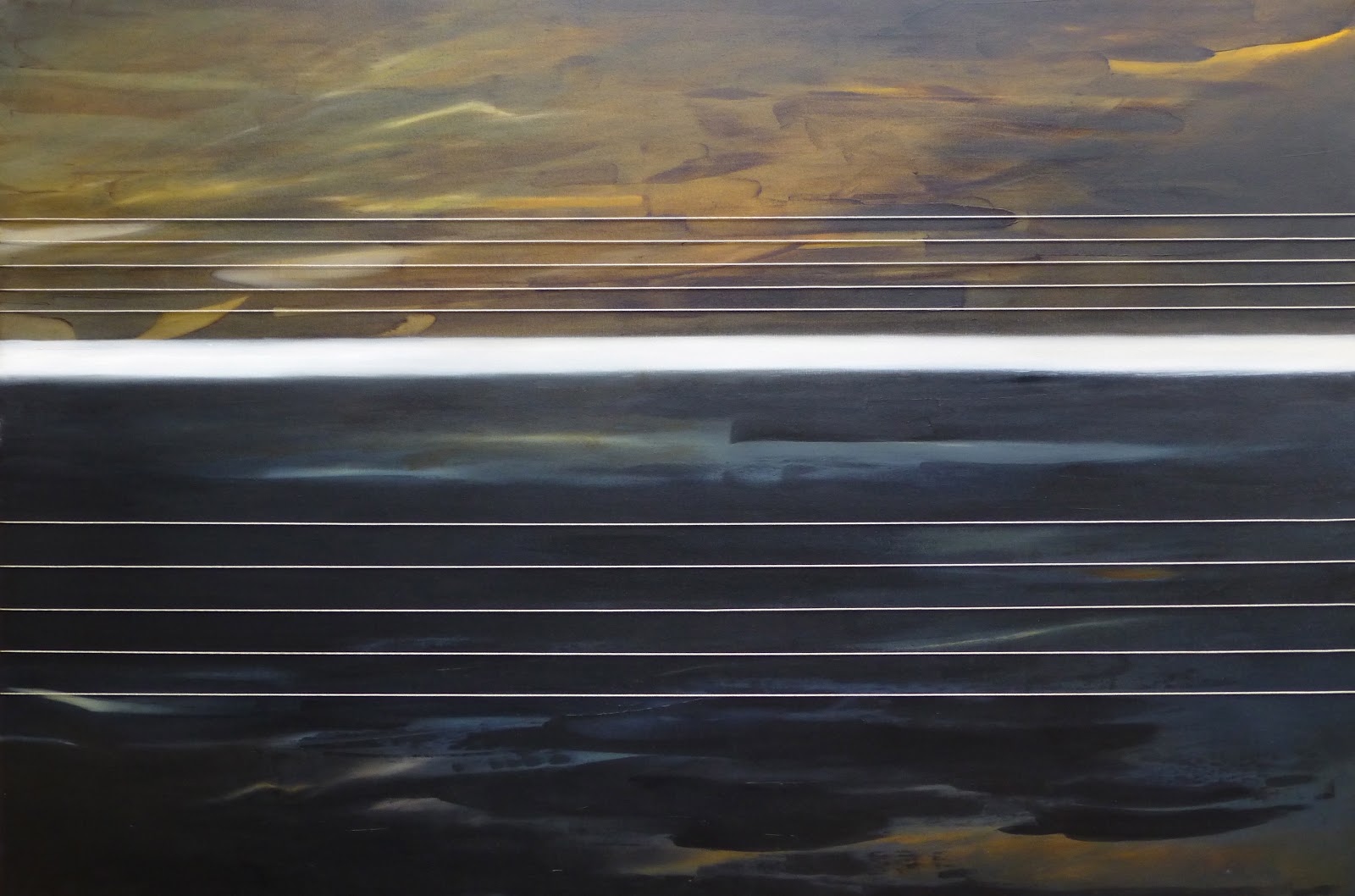
Oil & steel strings on canvas


Shadow and Shimmer
Oil, charcoal and thread on paper


The Sharp-Flat Cadences of Weather
Oil and thread on paper


Dream of the Sea
Oil and steel strings on canvas


Night Watch ii
Oil and Pastel on Paper


Tuesday, February 12, 2013

Tuesday Poem | THE LAYERS by Stanley Kunitz


                                    THE LAYERS

                                    I have walked through many lives,
                                    some of them my own,
                                    and I am not who I was,
                                    though some principle of being
                                    abides, from which I struggle
                                    not to stray.
                                    When I look behind,
                                    as I am compelled to look
                                    before I can gather strength
                                    to proceed on my journey,
                                    I see the milestones dwindling
                                    toward the horizon
                                    and the slow fires trailing
                                    from the abandoned camp-sites,
                                    over which scavenger angels
                                    wheel on heavy wings.
                                    Oh, I have made myself a tribe
                                    out of my true affections,
                                    and my tribe is scattered!
                                    How shall the heart be reconciled
                                    to its feast of losses?
                                    In a rising wind
                                    the manic dust of my friends,
                                    those who fell along the way,
                                    bitterly stings my face,
                                    Yet I turn, I turn,
                                    exulting somewhat,
                                    with my will intact to go
                                    wherever I need to go,
                                    and every stone on the road
                                    precious to me.
                                    In my darkest night,
                                    when the moon was covered
                                    and I roamed through wreckage,
                                    a nimbus-clouded voice
                                    directed me:
                                    “Live in the layers,
                                    not on the litter.”
                                    Though I lack the art
                                    to decipher it,
                                    no doubt the next chapter
                                    in my book of transformations
                                    is already written.
                                    I am not done with my changes.

                                    Stanley Kunitz


litter |ˈlitər|nountrash, such as paper, cans, and bottles, that is left lying in an open or public place: fines for dropping litter


• in sing. ] an untidy collection of things lying about: a litter of sleeping bags on the floor.the group of young animals born to an animal at one time: a litter of five kittens.material forming a surface-covering layer, in particular:• (also cat litter )granular absorbent material lining a tray where a cat can urinate and defecate when indoors.• straw or other plant matter used as bedding for animals.• (also leaf litter )decomposing but recognizable leaves and other debris forming a layer on top of the soil, esp. in forests.historical a vehicle containing a bed or seat enclosed by curtains and carried on men's shoulders or by animals.• a stretcher, for transporting the sick and wounded.


Over on the Tuesday Poem hub, Mary McCallum (Curator of TP and this week's editor) features well known NZ poet, C. K. Stead with The Gift. 

Oh, for lines as fine as these --- 


' . . . The tuis

still quote you
and even cicadas
manage a phrase

that sounds like yours.
Storms too in wooden
houses sometimes

creak of you. . .'


In her dazzling background commentary, Mary writes ". . . Contrary to the impressive solidity of such achievements, The Gift skips into its subject with its thirteen-syllabled tercets - the delight and sense of mischief, palpable. And it takes them off, the two poets - both geniuses of a kind - to the place of 'touch-and-go tides', in a way that makes me think of the marvellous poem by Bill Manhire, Opouterean elegy to friend and fellow writer Michael King who died suddenly, leaving behind another place of tides and fish. These sorts of insights into the lives of prominent NZ writers and their work - our writing history, if you like - I find fascinating. But it's also a lyrical poem about two blokes who hung out in the way blokes in this country do. . . " 


Tuesday, January 29, 2013

Tuesday Poem - "who are you, little i?" by e. e. cummings


                          "who are you, little i
                          (five or six year years old"
                          peering from some high 

                          window;at the gold

                          of november sunset

                          (and feeling that if day
                          has to become night

                          this is a beautiful way)"

                          e. e. cummings


After a month's break over the Southern Hemisphere's summer holidays, Tuesday Poem 2013 starts up again today. Hooray. It is my pleasure and privilege to be editor on the hub this week. I chose the poem Almost Always, Never Quite by Dunedin poet David Howard. David is NZ's new Burns Fellow - this coming Friday - 1 February - he will pull up his chair at the desk Emma Neale has happily occupied since this time last year.

Born in Christchurch, David Howard co-founded Takahe magazine (1989) and the Canterbury Poets Collective (1990). He spent his professional life as a pyrotechnics supervisor whose clients included the All Blacks, Janet Jackson and Metallica. In 2003 David retired to Purakaunui in order to write: 'The rural hinter is perfect for this; by getting clear of the social whirl you realise what matters is the dirt under your fingernails. 

*

In March 2012, fellow Tuesday poet Tim Jones interviewed David for the online journal, Cordite.  Here follows one of my favorite - postively crackling - excerpts from their discussion ---  


TJ: You have previously worked as a pyrotechnics technician and SFX supervisor for acts including Janet Jackson and Metallica. Has it left traces on your poetry?

DH: Pyrotechnics promised a wider collaboration with the musical, sporting and entrepreneurial worlds than was possible in literary New Zealand. While visceral, fireworks are impersonal and I wanted clear of the word writer. Perhaps my poems had come, like the trees of Birnam Wood, to rout the person who owned them. I withdrew from the submission-publication-review cycle. I fell silent, only it didn't feel like falling.
What then? Kenosis. Fireworks were and are part of that challenge to empty. They appear to dominate the sky but it's a percussive illusion; they get their power through surrendering to the night. By vanishing they stay with us. Seeing is not believing; belief comes after the seeing, when you're gazing at black. And with poetry you have to listen for what's not there. An attentive listener knows the word partners something larger than a dictionary definition. On tour, rigging in gantries, then packing out at four in the morning under security lights rather than the moon – it all helped me to weigh silence.
Designing fireworks displays, articulating space, gave me the strength to attempt longer poems: I was now confident of my ability to structure the unseen, the becoming. How? If site provides context then fireworks don't so much map as transcend it because they take the viewer into an apprehension of the eternal through the momentary. The report of a launching charge is more than a deafening report on experience. Exposed by the exploding shell, perhaps site is akin to the light-sensitive paper that photographs are printed on – but a paper that has not been treated with fixative. When the spreading charge transforms common chemicals into uncommon effects, then the audience participates more than the pyrotechnician. No exposure matches that of the spirit – it cannot be captured. After all, is this so different from what happens with language? Words turn around the world, searching the pockets of discarded jackets for secrets. See, here is a piece of crumpled paper. It is the charred casing of a star shell.
*

Glorious stuff! 

You can read the full interview here
(Thanks, Tim.)


Monday, January 28, 2013

NO ORDINARY MORNING


This morning's sunrise (yes, this is the sun, not the moon! - c. 6.00AM. 

Astonishingly, the serrated shadow 'form' is nothing more than vapor - the mist's light fingers.


Tuesday, December 25, 2012

Christmas


                  Celebration


                           Brilliant, this day – a young virtuoso of a day.
                           Morning shadow cut by sharpest scissors,
                           deft hands. And every prodigy of green –
                           whether it's ferns or lichens or needles
                           or impatient points of buds on spindly bushes –
                           greener than ever before. And the way the conifers
                           hold new cones to the light for the blessing,
                           a festive right, and sing the oceanic chant the wind
                           transcribes for them!
                           A day that shines in the cold
                           like a first-prize brass band swinging along
                           the street
                           of a coal-dusty village, wholly at odds
                           with the claims of reasonable gloom. 
                      Denise Levertov


Jeanette Winterson posted a startling new Christmas Story on her website a couple of days ago. She writes one every year - this year's is characteristically searing and illuminating. 

This evening we will light candles along the wooden boardwalk that winds its way through my garden, rustle together a pile of cushions and head outside to share poems (Melissa Green's Nativity, David Wagoner's The Silence of Stars, Jeanette's Moon series and this latest Christmas story. . .  We will take turns to read out loud to each other and an audience of trees, grass and stars. . . 


". . .  I keep a light in the window because there is a part of me that believes that the light will attract something - I don't know what - something that isn't a moth. I keep the light lit because I don't want to accept the inevitability of darkness. . . "


Love and blessings to you all this Christmas - may we keep our lights lit as we enter 2013,  a whole - and hope-full - new era. 

Friday, December 21, 2012

Oh!


"Nature will bear the closest inspection. 
She invites us to lay our eye level with her smallest leaf 
and take an insect view of its plain.'


                                          Henry David Thoreau, naturalist and author (1817-1862)


& 

then 

oh

&

then

there's

this

.

.


.


XO


Tuesday, December 18, 2012

Tuesday Poem - BIRD by Pablo Neruda


                BIRD
                        It was passed from one bird to another,
                        the whole gift of the day.
                        The day went from flute to flute,
                        went dressed in vegetation,
                        in flights which opened a tunnel
                        through the wind would pass
                        to where birds were breaking open
                        the dense blue air -
                        and there, night came in.

                        When I returned from so many journeys,
                        I stayed suspended and green
                        between sun and geography -
                        I saw how wings worked,
                        how perfumes are transmitted
                        by feathery telegraph,
                        and from above I saw the path,
                        the springs and the roof tiles,
                        the fishermen at their trades,
                        the trousers of the foam;
                        I saw it all from my green sky.
                        I had no more alphabet
                        than the swallows in their courses,
                        the tiny, shining water
                        of the small bird on fire
                        which dances out of the pollen. 
                   Pablo Neruda


Tui - photograph by Pippa Howard (my sister who came to Dunedin three weeks ago - first visit in 15 years!)


*


This week's editor on the Tuesday Poem hub is Helen Lowe
with All my life 

                          "So we sat, and the waves
                          crashed in like gifts, or insults. . . "


Birds is my final Tuesday Poem for 2012. What a year it has been: joys juxtaposed with terrors,  madness with miracles. Poetry provides a container for Life in all its crudeness and subtlety. Like music and the visual arts, it has an unsurpassable capacity to be both protest and prayer, rational and lyrical, cerebral and mystical. Poetry is balm. It is shaman. It is connection. And it is healing. 

Heartfelt thanks to Mary McCallum - unfaltering helmsman of our TP boat - for her remarkable dedication not only to poetry but also to us - poets and readers of Tuesday Poems. As far as I know nothing quite like our TP community is to be found 'elsewhere'. Without Mary, TP would not exist. I know I am not alone when I say how much I appreciate her constancy, her generosity of spirit and her zeal. I can't think of a week that's passed when our small community has not received welcome word from dear Mary. Come hell or high water, she is present; witty, humorous, big-hearted and supportive. You are a rare bird, Mary McC! This ecclectic little chorus of critters is singing their appreciation to you. . .  xo 


*


“To be hopeful in bad times is not just foolishly romantic. It is based on the fact that human history is a history not only of cruelty, but also of compassion, sacrifice, courage, kindness. What we choose to emphasize in this complex history will determine our lives. If we see only the worst, it destroys our capacity to do something. If we remember those times and places—and there are so many—where people have behaved magnificently, this gives us the energy to act … in however small a way, we don’t have to wait for some grand utopian future. The future is an infinite succession of presents, and to live now as we think human beings should live, in defiance of all that is bad around us, is itself a marvelous thing. . . " – Howard Zinn